A planner’s checklist: What telematics data can (and can’t) do for freight planning
Telematics data for freight planning complements traditional sources. Our checklists share what telematics data can and can’t do to support freight planning.

Chicago has some of the worst traffic in America. It also outperforms nearly every city studied in a new analysis of freight efficiency across nine major U.S. metros. That contradiction reveals some fascinating insights on what really keeps freight moving.
For decades, transportation planners and logistics operators have treated congestion and freight efficiency as essentially the same problem. Slow traffic means slow freight. Fix the roads, add lanes, and goods move better. It’s an intuitive equation — but according to real-world commercial vehicle data, that’s not the complete picture.
Altitude by Geotab recently analyzed medium- and heavy-duty commercial vehicle movement across nine U.S. cities throughout 2024, scoring each on three dimensions:
The final Altitude Freight Efficiency Score weights these together, with congestion carrying the most influence at 60% of the total score. You’d think the least-congested cities would win, but the results don’t work out that way. Understanding why reveals something important about what freight efficiency actually requires.
Here’s what carriers actually need from a city’s transportation network: not zero delays, but predictable delays.
For example, a truck driver who knows that the I-90 interchange adds 25 minutes on a Tuesday afternoon can plan for that. The dispatcher can adjust. The delivery window holds. Planners accept that chronic, foreseeable congestion is a cost of doing business in a major metro — it gets priced in and scheduled around.
What breaks supply chains is variance: A weather event that shuts down a critical corridor; a special event staged in a high-travel corridor; an accident at a single chokepoint that cascades into hours of delay because there’s no redundancy in the network. These are the disruptions that cause missed deliveries, idling trucks, wasted fuel and delivery penalties — and they have almost nothing to do with average congestion levels.
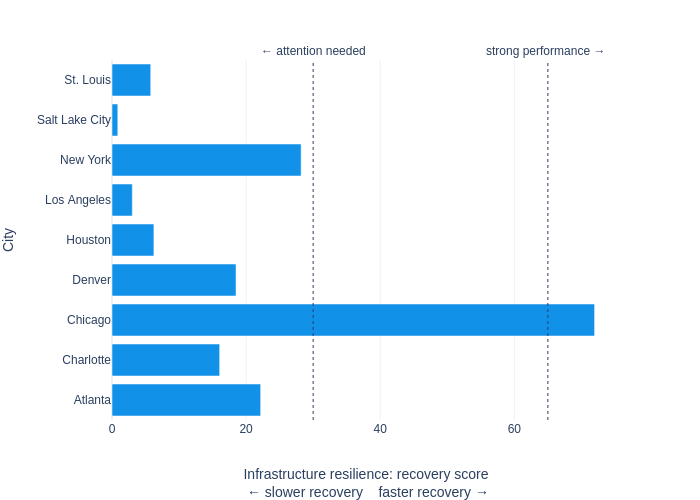
Figure 1: Infrastructure resilience scores for each of the nine cities Altitude analyzed. Higher scores indicate transportation systems that are able to recover faster from both small and large disruptions.
Chicago ranked first in infrastructure resilience by a significant margin in the Altitude analysis, meaning its network recovers faster from both small disruptions (sporting events, concerts) and major ones (severe weather, infrastructure incidents) than any other city studied.
Chicago’s high resilience reflects years of investment in route redundancy, emergency response coordination and institutional relationships between traffic management and freight operators. Chicago also benefits from one of the most extensive freight rail networks in North America, which absorbs commercial volume that would otherwise compete directly with trucks on urban roads.
The result is a city where freight keeps moving even when conditions deteriorate — which, in a place with Chicago’s climate and events calendar, is exactly the capability that matters most.
Denver tells a complementary story. Where Chicago demonstrates that resilience can overcome congestion, Denver shows that intentional policy choices create a measurable efficiency advantage even before a crisis hits.
Denver leads the study overall not by dominating any single category, but by performing consistently well across all three. Its congestion is manageable, its resilience is solid, and it records the lowest idling rates of any city analyzed. That last point is revealing: Denver and New York — cities with vastly different sizes, climates and congestion profiles — both score well on infrastructure externalities, and both have anti-idling enforcement in place for commercial vehicles.
The data makes a strong case that freight efficiency isn’t just built, it’s governed:
These are the kinds of decisions growing cities can make right now, before density makes them expensive or politically difficult.
A city doesn’t have to be uncongested to move freight well. It has to be designed to keep moving during disruptions, through bad weather and through the inevitable friction of operating a major logistics network in a dense urban environment.
Chicago proves that’s possible. Denver proves it can be reinforced by smart, low-cost governance. But the cities currently watching their freight efficiency erode while adding lane after lane shows what happens when planners keep solving for the wrong variable.
The goal is reliable freight, every day, no matter what. And it’s achievable.
How strong is your city’s freight economy? Get the Altitude Freight Efficiency Report to see what factors you should be measuring and improving to keep freight moving in your region.
Telematics data for freight planning complements traditional sources. Our checklists share what telematics data can and can’t do to support freight planning.
New data sources for MPO freight planning: 3 overlooked metrics that reveal regional trends before they hit your dashboard.
State DOTs can forecast truck traffic earlier by watching freight metrics from city and port data. Here are 3 signals worth tracking.