No federal accuracy standards exist for truck-specific AADT — a surprising gap given how critical commercial vehicle data is to bridge, pavement and freight planning.
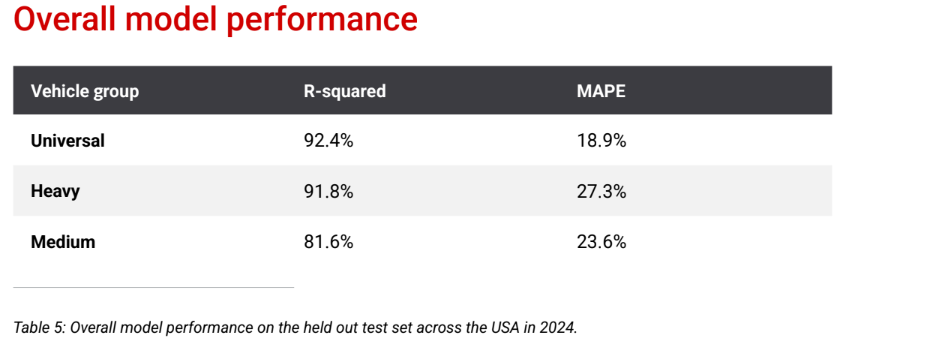
Published truck AADT error rates range from 41–96%. Altitude’s model achieves 27.3% for heavy-duty and 23.6% for medium-duty — the lowest on record at national scale.
Altitude is the only commercially available product with segment-level estimates for Heavy, Medium, and Universal vehicle groups — covering approximately 10 million road segments, including hundreds of thousands with no official count..
Three inputs power the model: observed GPS fleet data, contextual enrichment and HPMS ground truth — each essential, and more accurate together than any single source alone.
Altitude’s AADT version delivers estimates within 90 days of year end, compared to the 12–24 month publication lag of traditional HPMS data.
When a project specifically involves truck and freight infrastructure, you need commercial vehicle Annual Average Daily Traffic (AADT) to support federal counts. Commercial vehicle AADT fills in details planners may miss — for example, on corridors where no cameras or even counters exist. Commercial AADT reveals whether those miles traveled are from passenger vehicles or Class 8 long-haul trucks.
This latest version of our model includes updates that better support planners with reliable commercial-vehicle data: Direct vehicle-class modeling, calibrated prediction intervals on every estimate and directional AADT ready in 90 days instead of 12–24 months. Tested and proven, here is how our model provides commercial AADT to support planning, grant applications and more.
Creating the commercial vehicle AADT model
Altitude by Geotab is the only commercially available AADT product that provides segment-level estimates for Heavy and Medium commercial vehicles alongside universal traffic, covering approximately 10 million road segments across all 50 U.S. states, D.C., and Puerto Rico.
Surprisingly, there really is no benchmark for truck-specific AADT from existing sources. For example, there are no Federal Highway Administration (FHWA) accuracy standards for vehicle-class-specific AADT. The existing AADT benchmarks apply exclusively to total traffic volume, not broken out by vehicle class, type or vocation.
Altitude fills that gap. Truck-specific AADT is critical for freight corridor planning, bridge loading assessments and pavement design. The latest version of Altitude’s commercial vehicle AADT model introduces four substantive advances over previous approaches.
Medium and Heavy vehicles are now modeled directly from Highway Performance Monitoring System (HPMS) vehicle classification data, replacing the registration-ratio derivation used in earlier iterations — a change that grounds freight estimates in actual observed truck volumes rather than approximations.
Time series forecasting now provides accurate data in three months, instead of 12–24 months from HMPS.
Every estimate is now accompanied by confidence levels by road type and volume, so a high-confidence estimate on a major freight corridor is distinguishable from a lower-confidence estimate on a lightly traveled secondary road.
Estimates are now disaggregated by direction of travel — inbound and outbound — supporting use cases that require directional flow data.
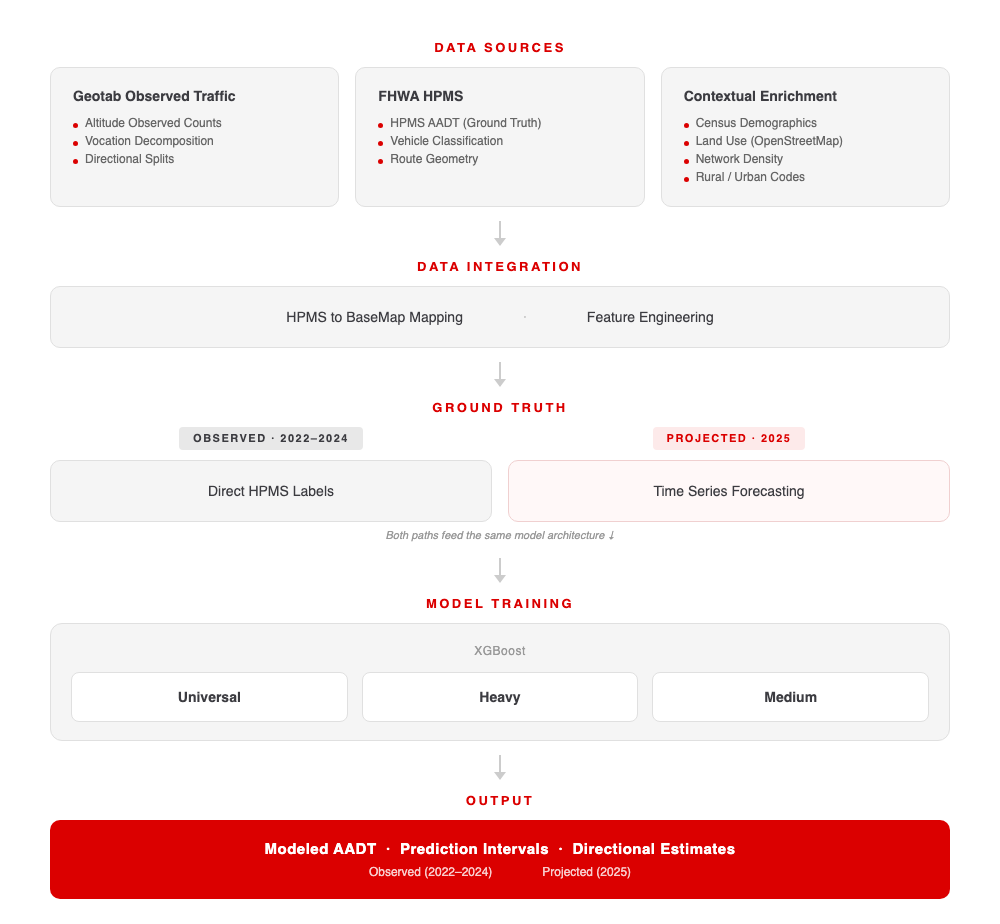
Altitude’s commercial vehicle AADT uses two complementary modeling approaches to create estimates across both observed and projected years.
Our model leverages volume and geospatial data from both the Federal Highway Administration (FHWA) and Geotab’s Altitude platform. Additional supporting data sources include census socioeconomic data, land use classifications and road network density features to enhance AADT modeling.
This model significantly improves data reliability, particularly on secondary roads where standard matching parameters produce poor alignment. This improvement in ground truth quality is the single largest accuracy driver in our data integration pipeline.
Figure 1: High level overview of Altitude’s commercial vehicle AADT modeling pipeline.
Commercial vehicle AADT accuracy in context
Not surprisingly, due to lower sample sizes, published research on other truck-specific AADT estimates show substantially higher error rates than total-vehicle estimation. Examples include:
A study of probe-based truck volumes in the Winnipeg Metropolitan Region found mean absolute percentage error (MAPE) ranging from 56% to 96% for medium- and heavy-duty categories.
A Kentucky DOT assessment of third-party truck traffic data reported MAPE of 41.2% when compared against short-term counts.
A probe-based truck AADT estimate across Texas, Ohio and Minnesota, documented a MAPE of 42.8% for heavy-duty categories.
By contrast, Altitude achieves a MAPE of only 27.3% for heavy-duty trucks and a MAPE of 23.6% for medium-duty.
How commercial vehicle AADT modeling works
Building our commercial vehicle AADT model relies on three inputs:
Geotab’s observed commercial traffic counts. Altitude by Geotab processes GPS traces from millions of commercial fleet vehicles, producing Altitude Observed Counts — the average daily commercial fleet crossings on each road segment across three vehicle groups: Universal (all vehicles), Medium (GVWR Classes 3–5), and Heavy (GVWR Classes 6–8). While Altitude Observed Counts reflect only Geotab-connected vehicles, it correlates strongly with HPMS AADT and our data is available for virtually every road where fleet vehicles travel, including hundreds of thousands of segments with no official HPMS count.
Contextual enrichment. Each segment is enriched with census demographics, land use classifications, road network density metrics and rural urban commuting area codes, providing the signals needed to translate commercial fleet counts into AADT estimates across diverse road environments.
Supervised learning against quality-controlled ground truth. Models are trained against ground-truth AADT labels spatially matched to Geotab’s BaseMap. The model learns the relationship between observed traffic and HPMS AADT on labeled segments, then applies that relationship to produce modeled AADT values across the full network.
Figure 2: Overall model performance for Altitude’s commercial vehicle AADT tested across the US in 2024.
Pairing Geotab’s high spatial resolution commercial traffic data with HPMS AADT strengthens our AADT model. By learning the relationship between these two data streams, the model produces segment-level estimates with a level of granularity, coverage and accuracy that neither data source could achieve independently.
The result is AADT data that’s ready to use: structured outputs with explicit confidence bounds, directional resolution, a documented quality standard and national coverage that is delivered within 90 days of year end. For planners who have been working with estimates and 12–24 month data lags, that timing can make the difference between a meaningful traffic plan and one that’s already outdated.
Standard Annual Average Daily Traffic (AADT)measures total traffic volume across all vehicle types. Commercial vehicle AADT breaks that down by vehicle class — isolating trucks and freight vehicles specifically — which is essential for infrastructure planning decisions that depend on load and volume by vehicle type.
No. FHWA accuracy benchmarks apply only to total traffic volume, not vehicle-class-specific estimates. That means there’s no official bar for how accurate commercial vehicle AADT needs to be — which makes choosing a reliable provider all the more important.
Altitude achieves a mean absolute percentage error (MAPE) of 27.3% for heavy-duty trucks and 23.6% for medium-duty — significantly lower than the 41–96% error rates documented in published research on competing approaches.
The model is trained on segments where HPMS ground truth exists, learns the relationship between Geotab’s observed fleet GPS data and official counts, then applies that relationship across the full road network — including segments that have never had a counter or camera installed.
It supports a range of planning and infrastructure applications including freight corridor analysis, bridge load assessments, pavement design and federal grant applications where defensible, class-specific traffic data is required.
Discover what truck parking data is available for transportation agencies, from journey thresholds to peak demand hours, to prioritize corridors and strengthen funding requests.
See the 3 commercial vehicle datasets transportation planners use most — harsh events, speed analysis, and origin-destination data — with real examples.