

A planner’s checklist: What telematics data can (and can’t) do for freight planning
Telematics data for freight planning complements traditional sources. Our checklists share what telematics data can and can’t do to support freight planning.

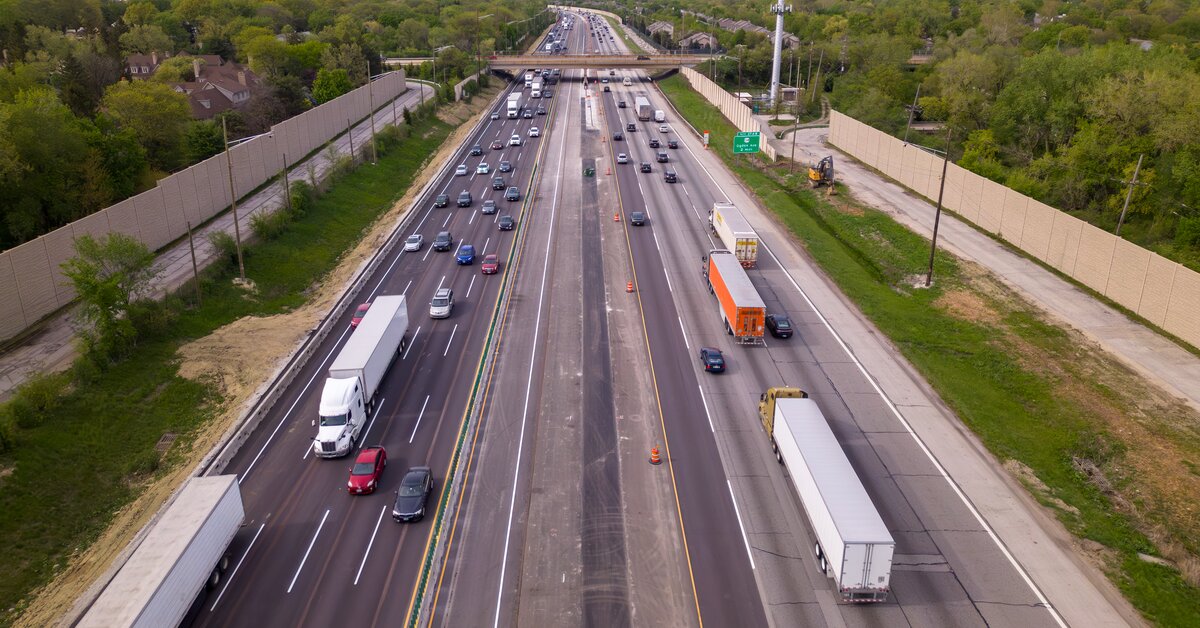
Behind every data point in a state freight plan is a commitment to human safety. With several thousand people injured or killed over the past five years in collisions involving trucks parked on ramps, solving this parking crisis is a moral and operational imperative.
This has been a nationally recognized problem for over a decade (Jason’s Law was established in 2012) that is now poised to receive up to $200 million in funding. Now is the time to delve deeper into analysis to guide planning and development.
Altitude by Geotab in partnership with HNTB analyzed over 120,000 long-duration truck ramp parking events, extrapolated to over 300,000 annual long-duration events nationwide. The emerging temporal patterns provide an empirical foundation that planners have lacked. This data allows agencies to move past anecdotal evidence and use verified analytics to identify where truck parking demand is highest. This data can help justify federal funding for capacity expansion through Infrastructure Investment and Jobs Act (IIJA) grant applications.
In general, the eastern United States experiences a higher number of ramp parking events than the western United States. A frequency analysis shows that ramp parking events are most common around Atlanta and Indianapolis, indicated on the map by clusters of high-frequency hexagons (colored in purple). Other hot spots include areas outside of Chicago, Nashville, Harrisburg and Allentown.
Ramp parking events in the west tend to follow major freight corridors. While hotspots like Indianapolis are the most acute, the presence of ramp parking across nearly every major corridor proves this is a systematic infrastructure deficit. It is not just a “Chicago problem” or an “Atlanta problem”—it is a national capacity failure.
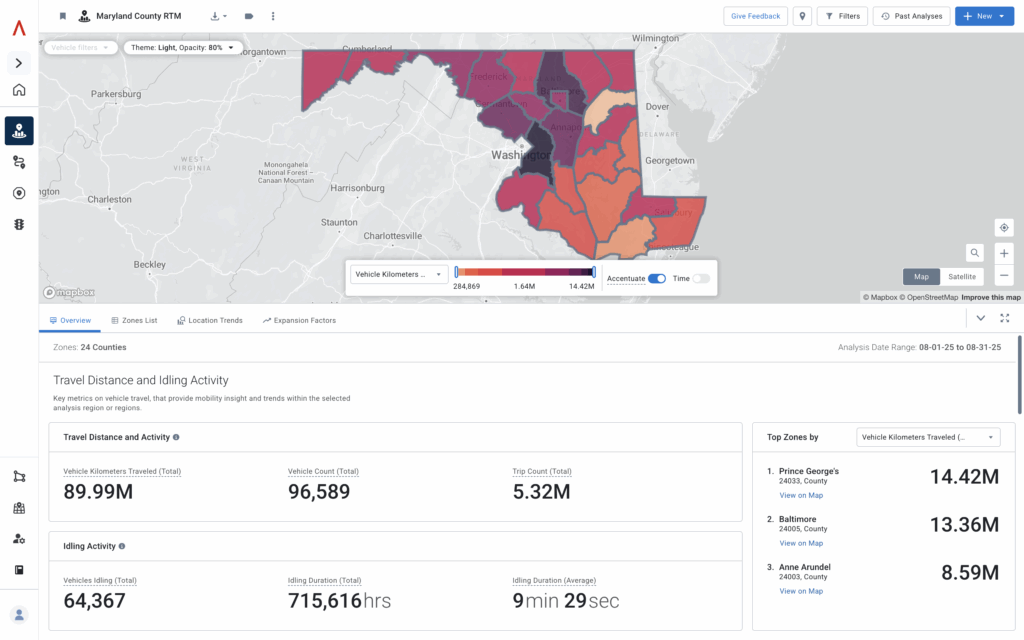
At the “crossroads of America,” Indiana tops the list for metro ramp parking activity and Indianapolis ranks highly on the state list. The subsequent rankings for states and cities correspond to highly populated urban areas in the United States — Atlanta, New York and Indianapolis. High state-level rankings like Tennessee (#3) highlight the impact of major corridor intersections (I-40, I-65 and I-81). These areas may lack large urban centers but they face massive “pass-through” parking demand.
| Top 5 States | Top 5 Metro Areas |
|---|---|
| Indiana | Atlanta–Athens-Clarke County–Sandy Springs (GA-AL) |
| Illinois | Indianapolis-Carmel-Muncie (IN) |
| Tennessee | New York-Newark (NY-NJ-CT-PA) |
| California | Washington-Baltimore-Arlington (DC-MD-VA-WV-PA) |
| Pennsylvania | Los Angeles-Long Beach (CA) |
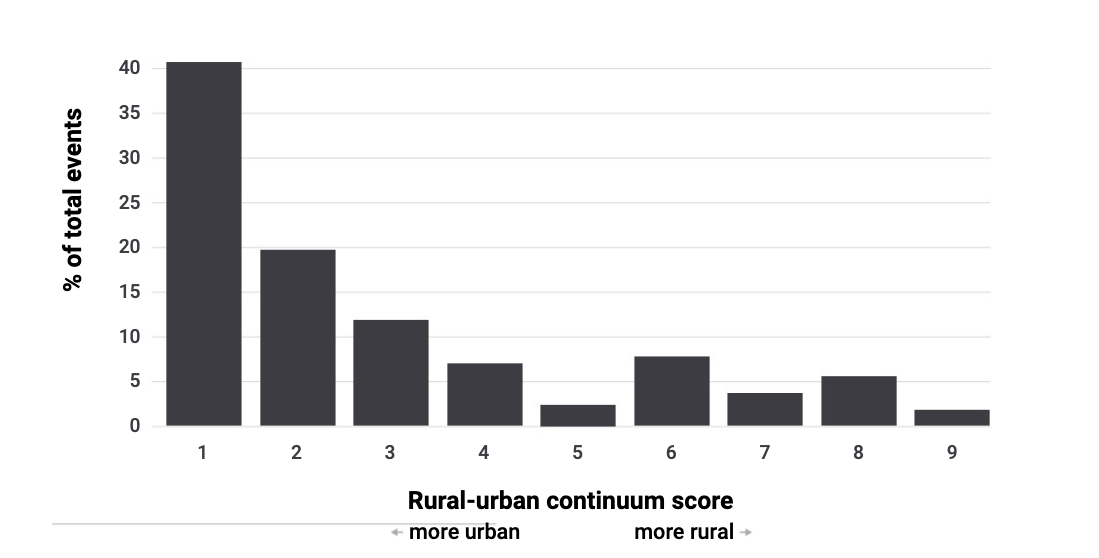
Urban areas present a particular challenge: They are congested spaces with intense trucking activity but also have high demand for land uses other than truck parking. This combination creates acute parking shortages that lead to high levels of unauthorized ramp parking.
While urban areas see high absolute numbers of ramp parking events, rural areas along major freight corridors also experience significant ramp parking. This suggests that the parking shortage permeates all high-volume freight corridors, regardless of whether they pass through a major city or a rural county.
Not surprisingly, parking events are most likely to begin between 8:00 pm and midnight. This timing suggests that as drivers approach Hours-of-Service (HOS) limits late at night, they find authorized facilities already at capacity, leaving them with no choice but to stop on a ramp or risk a regulatory violation.
Trucks parked by 8:00 pm typically remain on the ramp until between 5:00 am – 8:00 am the following morning. This means the majority of observed ramp parking events take place overnight. This creates heightened safety concerns for other drivers due to low visibility and unexpected stationary vehicles on infrastructure designed for moving traffic.
Day-of-week analysis reveals that Tuesday has the single highest peak of ramp parking events, closely followed by Wednesday. Friday through Sunday experience lower levels. This pattern reflects the busiest operational days for the trucking industry and aligns with weekly freight volume patterns.
Altitude’s analysis reveals a clear distance-duration threshold: A median journey of 520 miles with nine hours and 40 minutes of drive time—just shy of the 11-hour HOS limit—typically precedes a ramp parking event, while the median journey duration is nine hours and 40 minutes. This means that 50% of all journeys ending in ramp parking events exceed 520 miles and last longer than 9.7 hours.
It appears that drivers approaching their 11-hour driving limit or 14-hour duty limit face a critical decision: continue searching for authorized parking and risk exceeding their HOS limits (incurring fines and violations), or park immediately in whatever location is available — including highway ramps.
These data points indicate that HOS rules, in combination with the truck parking shortage, directly influence truckers’ decisions to park on ramps.
Altitude’s findings enable agencies to prioritize the best corridors for parking capacity expansion. Planners can turn to observed demand patterns rather than anecdotal evidence or uniform geographic distribution. Our report identifies the specific corridors with 5,000+ annual ramp parking events, providing the exact coordinates where new facilities or expanded rest areas would see high use.
Ready to get the data you need to address truck parking on your region’s interstate ramps? Download the full Nationwide Study of Truck Parking on Interstate Ramps report to help justify capacity investments and make meaningful safety gains.
Ramp parking events cluster most heavily around Atlanta and Indianapolis, which stand out as the highest-frequency hot spots. Other notable clusters appear near Chicago, Nashville, Harrisburg, and Allentown. Overall, the eastern U.S. sees more ramp parking activity than the western U.S., where events tend to track major freight corridors rather than concentrate around specific cities.
Most events begin between 8:00 pm and midnight, as drivers approaching their Hours-of-Service limits find authorized lots already full. Trucks that park by 8 pm typically stay put until 5:00–8:00 am the next morning, meaning the bulk of ramp parking happens overnight — raising safety risks due to low visibility. By day of week, Tuesday sees the highest volume of events, with Wednesday close behind; weekends (Friday–Sunday) see noticeably less activity, mirroring typical freight volume patterns.
It comes down to a forced tradeoff created by HOS rules and a shortage of authorized parking. As drivers near their 11-hour driving limit or 14-hour duty limit, they must either keep searching for legal parking (risking an HOS violation and fines) or stop immediately wherever space exists — even if that’s a highway ramp. The data shows a median trip of 520 miles and 9 hours 40 minutes typically precedes a ramp parking event, just under the 11-hour cutoff, reinforcing that time pressure — not driver choice — is the main driver.
By state: Indiana, Illinois, Tennessee, California, and Pennsylvania rank highest. By metro area: Atlanta–Athens-Clarke County–Sandy Springs (GA-AL), Indianapolis-Carmel-Muncie (IN), New York-Newark (NY-NJ-CT-PA), Washington-Baltimore-Arlington (DC-MD-VA-WV-PA), and Los Angeles-Long Beach (CA) top the list. Indianapolis’s strength as a freight crossroads helps explain both its city and state rankings, while Tennessee’s high state ranking reflects its position at the intersection of I-40, I-65, and I-81 rather than one dominant urban center.
Because ramp parking is a longstanding, federally recognized problem (Jason’s Law dates to 2012) now backed by IIJA funding, planners can use verified event counts — rather than anecdotal reports — to support grant applications. The analysis pinpoints corridors with 5,000+ annual ramp parking events, giving agencies specific coordinates and demand evidence to prioritize where new facilities or expanded rest areas would have the most impact.
Telematics data for freight planning complements traditional sources. Our checklists share what telematics data can and can’t do to support freight planning.
New data sources for MPO freight planning: 3 overlooked metrics that reveal regional trends before they hit your dashboard.
State DOTs can forecast truck traffic earlier by watching freight metrics from city and port data. Here are 3 signals worth tracking.