
5 ways freight corridor AADT data fills federal count gaps
5 ways freight corridor AADT data in 90 days supports federal counts—get timely, class-specific truck volumes for better planning.


Atlanta’s rank as the nation’s #1 metro for unauthorized truck ramp parking isn’t just a local problem — it’s a case study in truck parking demand analysis. Atlanta illustrates how freight hub geography, HOS regulations and parking infrastructure gaps interact.
Every region with a major freight corridor faces the same dynamics. Insights from studying Atlanta’s factors can help you solve your region’s freight parking problems, which create higher safety risks for truck drivers, other drivers, and cargo. These risks are why Safe Streets and Roads for All (SS4A) grants are now prioritizing truck parking issues. That’s a billion dollars in potential funding for your truck parking solutions.
We’ve known unauthorized ramp parking was bad, and now we can quantify it. Nationwide, approximately 330,000 long-duration ramp parking events occurred in the past year — over 900 per day. Altitude by Geotab’s analysis drew from 120,000+ actual parking events (Class 7-8 trucks, Nov. 2024–Oct. 2025) to identify long-duration stops. These are 9–12 hour stops, the kind mandated by federal Hours-of-Service (HOS) rules, not quick breaks.
Atlanta–Athens-Clarke County–Sandy Springs ranks #1 among all U.S. metro areas for long-duration ramp parking events, and Georgia ranks #8 among all states. The key infrastructure driver for Atlanta is that I-75, I-85 and I-20 converge in the metro, creating enormous through-freight volumes layered on top of intense local distribution activity. More long-haul freight volume drives the need for more parking.
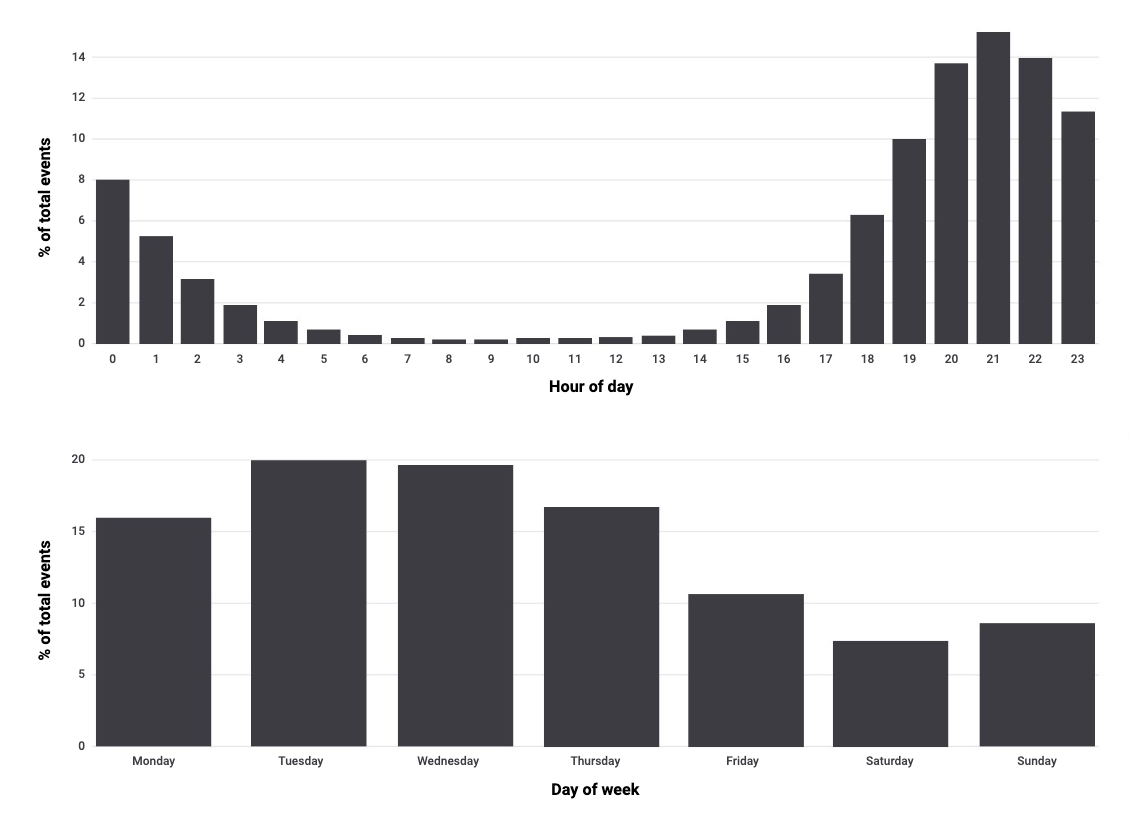
Figure 1: Altitude’s truck parking demand analysis reveals ramp parking event frequency by hour of day and by day of week.
Quantifying the local exposure: A metro area logging 100,000 annual ramp parking events translates to roughly 57 trucks parked on ramps on a typical Tuesday night at 9pm.
Atlanta’s combination of interstate convergence, massive warehousing footprint and regional distribution role creates compounding parking demand. The same pattern appears wherever major interstates intersect near large population centers — Indianapolis (#2), Chicago (#6), Dallas-Fort Worth (#7) and Charlotte (#12) all reflect the same dynamic.
Key insight: Regions serving as interchange points between major freight corridors, or ones with rapidly expanding warehouse/distribution footprints, show strong indicators that overnight parking demand is outpacing authorized supply. The data now exists to measure your risk level rather than guess at it.
The median journey before a ramp parking event is 520 miles and 9 hours 40 minutes — just short of the federal 11-hour driving limit. Atlanta is within 500 miles of most of the Southeastern U.S. via multiple major highways, making it a convenient overnight hub for drivers traveling across the region.
Key insight: Planners in hub cities can use this threshold to identify their most vulnerable corridors without waiting for a custom study. Draw a roughly 500-mile radius from your major freight origins and ask yourself where overnight parking supply thins out along those corridors. That gap zone is where ramp parking concentrates — and where infrastructure investment will have the highest impact per dollar.
All areas we studied had a Tuesday/Wednesday peak — driven by mid-week delivery cycle pressure — and its 8pm–midnight parking start window gives planners a precise diagnostic frame. The report even provides a conversion table: A corridor logging 10,000 annual ramp parking events has roughly six trucks parked on ramps on a typical Tuesday night at 9pm.
Key insight: This gives planners a concrete, communicable number for elected officials and funding bodies. Rather than citing aggregate annual totals, you can say: “On a typical Tuesday night, our corridor has X trucks parked on ramps within a Y-mile stretch.” That’s a safety and liability statement, not just a planning abstraction.
Atlanta’s land costs and density mean new parking facilities can’t realistically be built where demand is highest. The report finds that roughly 30% of long-duration ramp parking events occur in rural counties, demonstrating that trucks spill outward along corridors when metro-area parking is full.
Key insight: Smaller cities and rural corridor communities along major freight routes — the kind often outside MPO boundaries — absorb overflow demand generated by metros they didn’t create. Regional coordination across jurisdictional lines isn’t optional; it’s structurally necessary. If your MPO or DOT planning boundary stops at the metro edge, your parking strategy has a gap.
The report pegs average heavy-truck collision costs at $163,000 per incident, and notes that static 80,000-lb. loads on ramp pavement designed for moving traffic accelerate infrastructure deterioration. Random parking spots expose cargo to theft. Unexpected ramp parking heightens risk for passing drivers, and for truckers entering and exciting their vehicles. These risks are why SS4A grants are now prioritizing truck parking initiatives.
Key insight: Planners often struggle to compete for discretionary infrastructure funding without a cost-avoidance ROI argument. The collision cost figure, combined with locally observed ramp parking frequency, gives any DOT or MPO a defensible dollar estimate of avoided costs from parking capacity investment — the kind of number that survives scrutiny in a grant application or legislative budget hearing.
These are not Atlanta recommendations. They are a replicable analytical and advocacy playbook.
Step 1 — Quantify before you plan. The telematics-based methodology used in Altitude’s platform can perform corridor-level analysis anywhere in the country. Before developing parking strategies, establish a baseline: How many long-duration ramp parking events occur on your key corridors, when, and following what journey distances? Without this, investment prioritization is guesswork.
Step 2 — Identify your 500-mile freight shed. Map the major origins and destinations driving long-haul truck traffic through your region. Where do trucks hit the 9–10 hour driving mark relative to your corridor? That’s your highest-risk overnight parking gap, and likely your strongest case for capacity investment.
Step 3 — Build the Tuesday-night number into your public narrative. Annual aggregates are hard to visualize. A specific number of trucks parked on a specific ramp on a specific night of the week is not. Translate your data into that frame for stakeholder communication.
Step 4 — Expand your planning boundary to the corridor, not just the metro. Coordinate with adjacent rural MPOs, regional planning commissions and state DOT district offices along freight corridors. Overflow parking doesn’t respect jurisdictional lines, and neither should the solution.
Step 5 — Engage private developers with demand data, not just advocacy. The report identifies corridors with 5,000+ annual ramp parking events (14+ per day) as having sufficient demand to support new private facilities. If your corridor clears that threshold, you have a developer pitch, not just a public investment ask. Overnight-optimized reserved parking models (not traditional truck stop amenities) are the product type the data supports.
Step 6 — Treat real-time parking information as a near-term, lower-capital intervention. Physical capacity takes years to permit and build. Pilot programs testing real-time parking availability systems can reduce ramp parking in the near term while longer-term infrastructure solutions move through planning and funding cycles. The telematics infrastructure to evaluate pilot effectiveness already exists.
Ready to move from recognizing the problem to securing infrastructure funding? Download the full truck parking demand analysis to see the corridor-level data you need to justify capacity investments and make meaningful safety gains.
5 ways freight corridor AADT data in 90 days supports federal counts—get timely, class-specific truck volumes for better planning.
After 12 months of NYC congestion pricing, Altitude by Geotab data shows commercial fleets increased trip efficiency by 15%, adapting their operations and vehicle types.
One year of NYC congestion pricing data reveals fewer commercial vehicles making 15% more trips despite tolls, with traffic speeding up on 37% of roads.